Machines · Vehicle guide
Arctic Drive vehicle guide: repairs, parts and driving
Understand Arctic Drive’s car-centric loop: damage, fluids, weight, engines, tires, winches, trailers and the confirmed Reno and Buck Warden models.
 WP 04
Waypoints / 10 sections
In most survival games, the base is a fixed place you return to. In Arctic Drive, the base has wheels. The car carries your supplies, powers your heat, stores your loot and decides whether the next point of interest is reachable. Lose it and the run does not become harder; it becomes a walk in a frozen wasteland.
This guide covers the confirmed vehicle models, the systems the in-game panels expose, and the maintenance habits that follow from the official mechanics. It does not publish invented horsepower figures or a fake tier list; the game is still being balanced.
The car is the run
The Steam description is unusually direct: Arctic Drive is “built around one fragile thing: your car.” The cold kills you slowly, but the icy road kills the car fast. That sentence explains the whole design: the environment pressures the player, and the vehicle converts that pressure into a resource problem.
The confirmed systems that make the car a survival system rather than a vehicle skin:
- Physics-based damage: chassis and parts deform on impact.
- Part swapping and repair: engines, tires, heaters, chains, winches, storage and body parts can be found, swapped and repaired.
- Fluids: fuel, oil and radiator water are tracked; a dry radiator now warns you while driving.
- Weight: physical cargo changes speed and fuel use.
- Mobile bases: trailers and RVs can carry benches, storage, power and heat.
- Co-op: one to four players share the vehicle, the supplies and the consequences.
The confirmed vehicle lineup
The public record names more vehicles than the store page suggests. These are the models we can confirm from developer patch notes, the press kit and official screenshots — without inventing stats:
| Vehicle | Type | Confirmed detail | Source |
|---|---|---|---|
| Facia Reno 12-4S | Starting car | Introduced as the new starting car in July 2026; 1978 four-cylinder engine. Later patches fixed Reno interiors, mirrors and four-player seating. | Steam patch notes |
| N100-2S | Compact car | Two-seater version of the N100-4S, pitched for smaller expeditions and efficient road trips. | Update 0.9.4 |
| N100-4S | Car | Named as the four-seat counterpart to the N100-2S. No separate public spec sheet. | Update 0.9.4 |
| Buck Warden | Pickup | The garage poster reads “BUCK 130 WARDEN.” It became 4WD in September 2026; a later patch fixed a two-seat backseat. | Steam patch notes |
| Trailers | Mobile base | Can be attached, heated, powered, built inside and used as a crafting base. Consumes fuel while attached. | Camper update |
| RVs / campers | Large mobile base | Bunks, microwave, radio, storage and camper crafting. The exact difference from a trailer is not documented. | Press kit |
The engine panel explained
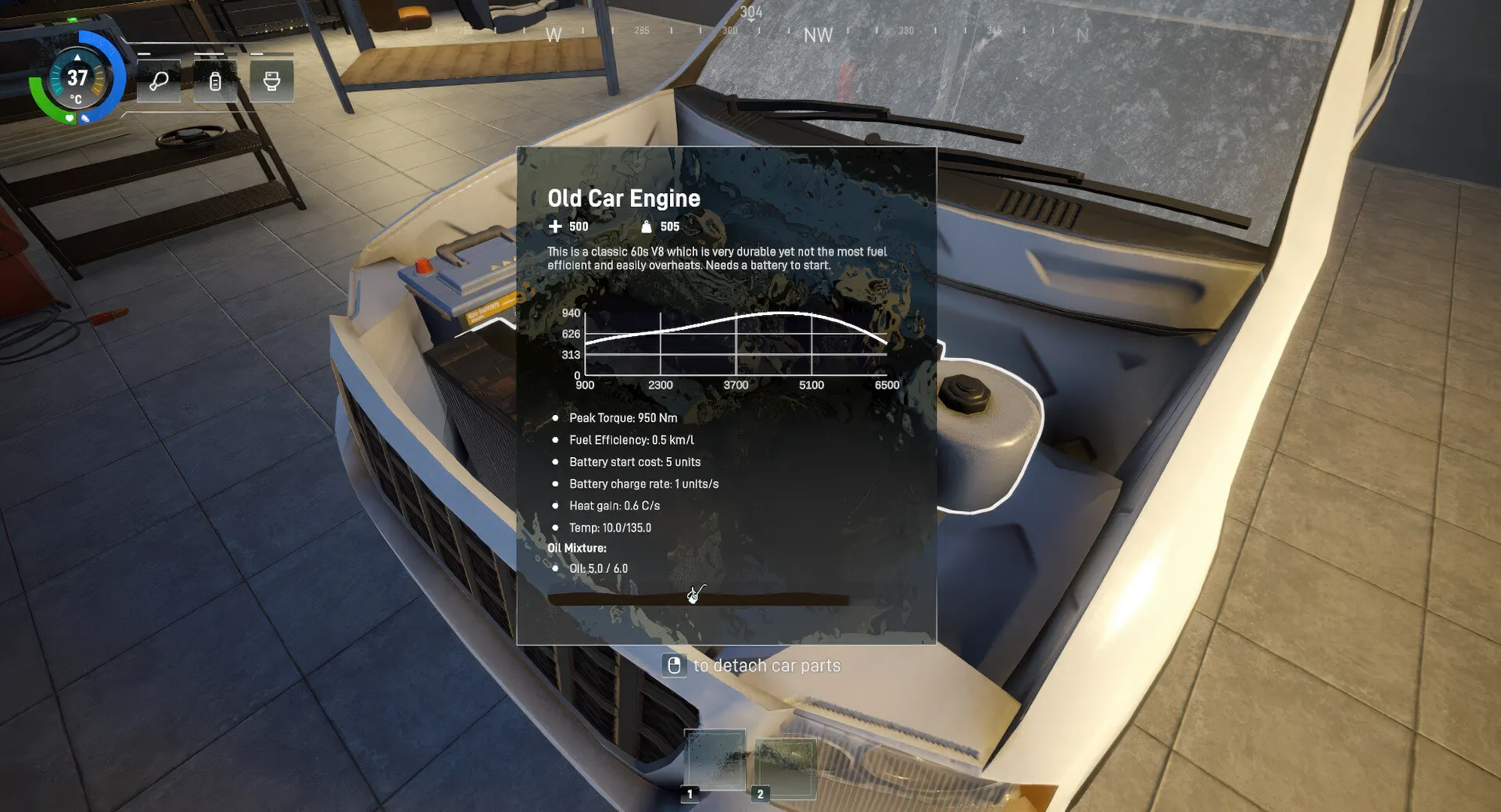
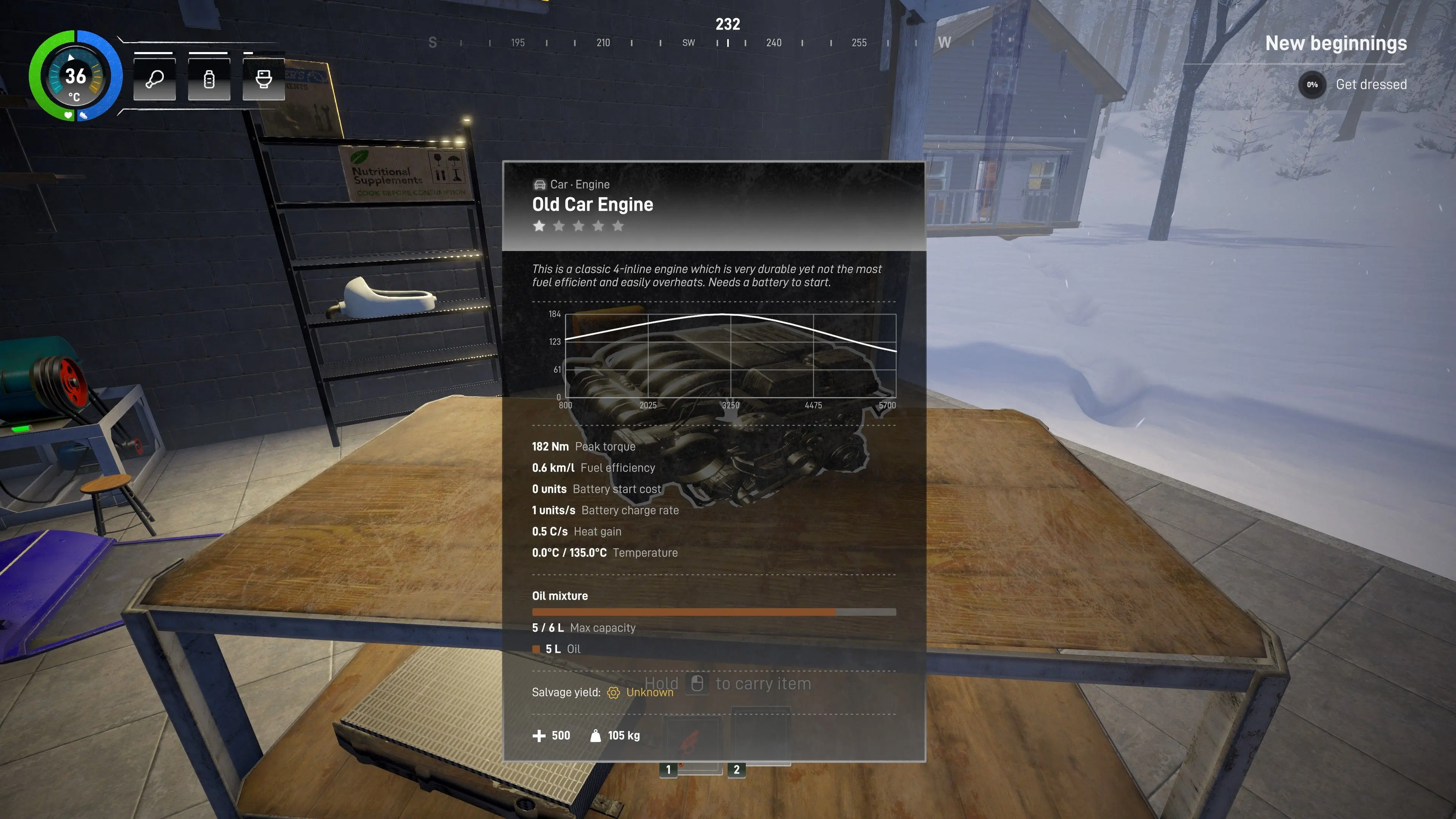
The official engine screenshot is one of the most useful pieces of UI evidence in the game. The Old Car Engine panel lists:
- Peak torque — the engine’s pulling strength.
- Fuel efficiency — expressed in km/L on the panel.
- Battery start cost and battery charge rate — the electrical side of starting and running.
- Heat gain — how quickly the engine produces heat, which matters in a cold cab.
- Temperature range — the engine’s operating window.
- Oil mixture and capacity — a maintenance bar, not a cosmetic.
The tooltip also says the classic four-cylinder is durable but not the most fuel-efficient and easily overheats, and that it needs a battery to start. That is a design hint: a cheap engine can be reliable and still be the wrong choice for a long, loaded leg.
When you inspect a new engine, compare it to the engine you already have, not to an absolute ideal. More torque may help a trailer; better fuel efficiency may matter more when the next station is uncertain; heat gain may be a comfort feature in winter. The panel gives you the trade-off. The road decides which side matters.
Damage, repairs and fluids
Damage is simulated at the chassis and part level. A crash is not a single health bar: parts can deform, doors can take damage, and the vehicle’s handling can change. The closed beta added weight values to all vehicle parts and improved player impact systems. Demo v0.19.2 made vehicle deformation more consistent across vehicle sizes and fixed crashes into breakable objects.
Confirmed repair and maintenance items:
- Repair kits, levels 1–3 — tiered consumables. The exact repair amount is not published.
- Radiator water — the radiator now warns when it is dry while driving. A spare radiator was added to the starting area in demo v0.19.2.
- Oil — the engine panel tracks oil mixture and capacity. The game does not publish a universal service interval.
- Battery — needed to start the Old Car Engine; charge rate and start cost are on the panel.
- Doors and body parts — front and rear doors appear as craftable parts in official screenshots.
- Sledgehammer — a physical tool used for breaking and building; walls broken with it persist after a save.
Repair before the next leg, not after the next crash. A damaged chassis changes how the car behaves under load, and a repair kit spent in a garage is cheaper than a repair kit spent in a blizzard.
Weight, cargo and fuel
Every object in Arctic Drive is physical. If you can lift it, you can load it — into the trunk, the back seat, a cargo box, a trailer or an RV. The cost is weight: the press kit says cargo weight slows the vehicle and burns fuel faster. A tight turn can spread the haul across the snow.
Practical loading rules:
- Dense, heavy items low and forward. A truck bed full of loose heavy parts is a physics problem waiting for a corner.
- Keep emergency supplies accessible. Fuel, a repair kit, water and a light source should not be buried under decorative loot.
- Use containers. Cargo boxes, transport boxes and shelves exist for a reason. A box also makes a crash easier to recover from.
- Match the load to the next leg. A full trailer is a commitment to a route. If the road is uncertain, travel lighter and return for the rest.
- Watch the fuel gauge, not just the distance. The Steam page’s own line is that the Arctic will not kill you, but the fuel gauge will.
The July 2026 patch added craftable 20-liter jerrycans. A jerrycan is a reserve, not a license to ignore consumption. Use our fuel range planner to calculate a safe range from your own HUD numbers.
Tires, chains and traction
Tires are confirmed findable parts that change grip and driving feel. Tire chains are listed among the winter upgrades. A winch is confirmed recovery equipment. The exact grip values, speed limits and fitting rules are not public.
One official screenshot gives a useful warning. The Sponello Summer Tire’s tooltip says driving with it “is a risky choice, grip is purely theoretical here.” That is the game telling you that a summer tire is a stopgap, not an upgrade. In a winter survival game, the best tire is the one that keeps the car pointing in the direction you chose.
The Buck Warden became 4WD in September 2026. That does not make it immune to ice; it changes how the vehicle can put power down. A 4WD pickup with a loaded trailer is still a heavy object on a slippery road.
Trailers, RVs and recovery
Trailers are the mid-game upgrade that changes the shape of a run. The August 2026 update added crafting and cooking benches, transport boxes, heaters and electricity to trailers. Trailers now consume a small amount of fuel when attached, and crafting from a trailer bench consumes fuel. Demo v0.19.2 made trailers easier to attach.
RVs and campers are the larger mobile-base option. The press kit lists bunks, a microwave, a radio and storage, plus solar panels, extra batteries, heaters and lights. The exact difference between an RV and a trailer — mass, fuel use, module slots, driving feel — is not documented.
Recovery is a planning problem, not a button. Carry a winch if you plan to leave the marked road. Carry a spare tire or repair kit if you plan to drive fast. Carry a second person if you plan to make jokes about the handbrake at full speed; the press kit already knows.
Driving habits that save runs
- Drive the load, not the speedometer. A loaded trailer needs earlier braking and wider turns.
- Use the zoom and camera. Right-click zoom is confirmed while driving or as a passenger; third-person helps with trailers.
- Do not commit to an unmarked detour on a low tank. A shortcut is only a shortcut if it has an exit.
- Scrape the windscreen. Frost is a real visibility mechanic, not decoration.
- Listen to the engine and watch the temperature. The Old Car Engine is described as easily overheating. A warning is cheaper than a failure.
- Park facing your escape. In a storm or a bad POI, a three-point turn can cost more than the loot is worth.

Maintenance checklist
| Check | When | Why |
|---|---|---|
| Engine panel | Before a long leg and after a crash | Torque, efficiency, heat and oil are all visible in one place. |
| Radiator water | Before driving after a repair | A dry radiator warns while driving; heat damage is expensive. |
| Oil mixture | After heavy towing or a long climb | The panel tracks mixture and capacity; neglect is a breakdown risk. |
| Tires and chains | Before snow, ice or a heavy load | Grip is the difference between a corner and a crash. |
| Battery | After repeated starts or a cold night | The engine needs a battery to start; charge rate matters. |
| Cargo | Before every drive and storm | Loose weight moves, spills and burns fuel. |
| Fuel reserve | Before leaving a known POI | The return leg is part of the trip. |
What is still unknown
- The current engine, tire and part stats at Early Access launch.
- Whether all parts fit all vehicles or there are model-specific slots.
- The exact repair amount of each repair kit tier and whether chassis deformation is fully repairable.
- How much fuel a trailer consumes when attached, and how load weight modifies it.
- The real difference between an RV and a trailer in handling, fuel and module capacity.
- Whether wheels or tire chains have durability and how they fail.
- Which vehicles are planned for Early Access and beyond; no names have been announced.
Sources & verification
Checked November 7, 2026We link to the primary source for each factual claim. Store pages and developer announcements can change after publication; the access date records what we saw.
- 01Arctic Drive on Steam
Valve / Bonus Stage Publishing · Official store page
Release date, features, Early Access statement, system requirements, languages, categories and screenshots.
- 02Arctic Drive press kit
Bonus Stage Publishing · Press kit
Key features, platforms, release date, screenshots and key art.
- 03What we did in July!
Pebbles Games / PlayTogether Studio · August 6, 2026 · Developer announcement
Starting car: Facia Reno 12-4S with a 1978 four-cylinder engine.
- 04Update 0.9.4 drops for playtesting!
Pebbles Games / PlayTogether Studio · July 11, 2026 · Developer announcement
Research Station and blueprints, six crafting categories, N100-2S, snow overhaul, water cooler.
- 057 updates in 3 days?! What was added?
Pebbles Games / PlayTogether Studio · September 3, 2026 · Developer announcement
25 km maximum travel distance, right-click zoom, Reno and Buck Warden handling, Buck Warden 4WD, imperial units.
- 06Update: Camper Crafting!
Pebbles Games / PlayTogether Studio · August 19, 2026 · Developer announcement
Trailer mobile base, heaters and electricity, transport boxes, physical blizzards.
- 07Arctic Drive is in the Top 50 of most-played demos last Next Fest + v0.19.2!
Pebbles Games / PlayTogether Studio · October 27, 2026 · Developer announcement
Demo v0.19.2 additions and fixes, including revival kits for 2–4 player groups.
- 08The beta is ending, here's what has been added into the game!
Pebbles Games / PlayTogether Studio · June 18, 2026 · Developer announcement
Save/load, crafting overhaul, Organic resource, Abandoned Factory, proximity voice chat, damage and cargo systems.
- 09New patch v0.11.7 is live for playtesters!
Pebbles Games / PlayTogether Studio · July 24, 2026 · Developer announcement
Biomes, 20 L jerrycans, protein bars, repair kit levels 2 and 3.
Found a source that has changed or an error? Send a correction.
Spotted something out of date? The correction route is always open.
Send a correction